Oxygen Therapy

For more information visit our Oxygen Therapy page
Our bodies cannot store oxygen.
Your physician has prescribed oxygen therapy adapted to meet your needs.
If you decrease the use of your oxygen, the benefits will be reduced or disappear.
Your physician will prescribe the:
- Flow rate: this is the amount of extra oxygen your body will need. Your physician may want your flow rate to always be the same or you may need to change the flow rate for different activities such as resting, sleeping or exercising. Your flow rate is expressed in litres per minute (Lpm).
- Duration of use: this refers to the number of hours per day in which you should use your oxygen therapy. usually, 16 - 24 hours of use per day is required for your therapy to be effective. Your physician will advise you of your needs.
- Type of oxygen supply equipment to use: Your physician will recommend different supply systems based on funding and what is available to enhance your lifestyle. Air Liquide Healthcare can assist you with your choice of equipment from our broad range of oxygen supply systems.
Oxygen therapy prescription examples:
1) Use oxygen for at least 16 hours per day at 2 litres per minute (Lpm)
OR
2) Use oxygen for 16 hours per day at:
- 3 Lpm when sleeping
- 2 Lpm when resting
- 3 Lpm on exertion
Always use the flow rate prescribed by your physician - DO NOT vary it!
Contact your prescribing physician if you feel that the prescribed flow of oxygen is not meeting your needs.
Everyone is tested when they first get oxygen therapy to ensure the right amount.
If new symptoms show up, like headaches, increased sleepiness or confusion, you should contact your doctor or nurse.
Oxygen cylinders contain oxygen in gas form. they are filled under pressure to contain a greater volume of gas. The pressure is released with the use of a regulator which is also used to set the prescribed flow rate.
Cylinders can also be used with an oxygen conserving device which only delivers a flow of oxygen when you breathe in. your cylinder will last much longer since there is no oxygen flowing when you breathe out.
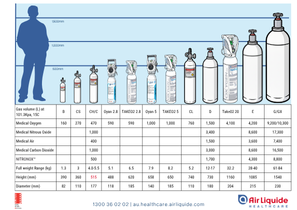
Oxygen cylinders are available in a variety of sizes and are separated into two main groups; portable and stationary.
Portable (small) cylinders are lightweight cylinders used outside of the home, and are available in a variety of sizes. Smaller models are contained in a bag which can be carried over your shoulder or used as a backpack.
The larger models can be transported using a trolley. Stationary (large) cylinders are normally used as a safety ‘back up’ for stationary oxygen concentrators in the event of power failure or equipment malfunction.
They are available in a variety of sizes. selection is based on your prescribed flow rate and how far away you live from an Air Liquide Healthcare office.
Your physician will provide your medical oxygen prescription. Air Liquide Healthcare will assist you in selecting the equipment best suited to your needs.
Your physician will decide whether you require oxygen at home and/or when you leave the house.
Air Liquide Healthcare will help you select the equipment that best suits your needs.
Oxygen can be provided through three main supply systems. These systems may be used alone or indifferent combinations.
Systems include:
- Stationary oxygen concentrators
- Portable oxygen concentrators
- Oxygen cylinder
Stationary Concentrator
An oxygen concentrator is an electrically driven device that extracts the oxygen from room air.
This means that the concentrator never runs out of oxygen and never needs to be refilled. Most stationary oxygen concentrators weigh anywhere between 18 – 30 kg and cannot be used outside of the home.
Stationary oxygen concentrators feature oxygen sensing devices that will warn you if the purity of the oxygen delivered decreases, so that you can use an alternative oxygen supply system and contact Air Liquide Healthcare for assistance.
Portable Concentrator
Portable oxygen concentrators (poc) operate in a similar way to stationary oxygen concentrators but are designed to be used while you are outside of the home. The weight of portable oxygen concentrators varies between models, ranging from 2 - 8kg. As a general rule, heavier pocs are capable of delivering higher oxygen flow rates. The battery duration for portable oxygen concentrators varies between models. Batteries are recharged from your mains power at home, and most have connections to recharge from your vehicle. Your poc should be serviced regularly to ensure that it is working properly and that the oxygen purity stays within the manufacturer’s recommendations. Since the amount of oxygen produced varies greatly between models, you will need to be tested on the specific device you intend to use to ensure that it will meet your oxygen needs.
Oxygen is typically delivered from the supply system to your nose with a ‘cannula’. extension tubes are available in a variety of lengths (up to 15 metres) to allow you to move about the house while connected to your oxygen supply system. Both the cannula and the extension
tubing are available in a variety of sizes and lengths. Based on your prescription, Air Liquide Healthcare will assist you in choosing accessories.
Firesafe cannula valves* can be connected to your oxygen accessories to provide an extra line of defence, that can limit the impact of an oxygen fire by automatically arresting the oxygen flow in the event of a fire.
Other specialty accessories are available as prescribed by your physician.
Your cannula will become dirty and brittle with use and may hurt your ears and skin if not replaced at least once to twice a month.
Extension tubing is disposable and should be replaced every three to six months to ensure that no leaks occur.
The firesafe valve is typically replaced every six months.
If your nose becomes dry or sore you can use a product such as Nozoil, which is safe to use with oxygen therapy. You should never use any petroleum based products (such as creams and oils) with oxygen.
If your ears are sore, you may want to try a product such as eZ Wraps - soft foam tubes that fit over the cannula. They provide a soft cushioning for the sensitive tissue around your ears.
If you are experiencing discomfort from your oxygen therapy contact Air Liquide Healthcare for assistance.
Learn More - About our range of oxygen consumables
Shop Now - Visit our online store to purchase these products
Support groups are invaluable for oxygen users, their carers and family. meeting people going through similar life changes can be encouraging and enlightening.
Support groups offer an opportunity to network, learn and share skills to help in a range of issues associated with health problems such as feeling low, irritability, isolation and confusion. There is also a strong focus on how to stay healthy and active.
There are a variety of established support groups including support from your area health service and Lung foundation Australia. for information on a lung support group nearest you, please contact your local healthcare facility or Lung foundation Australia: https://lungfoundation.com.au/find-support/